Understanding gRPC: MuleSoft’s Latest Addition
When MuleSoft recently announced native support for gRPC, many developers saw it as just another protocol added to the platform.
But after spending some time understanding what gRPC actually is, I realized this is a much more significant step.
If you’ve ever wondered:
- What exactly is gRPC?
- How is it different from REST?
- Why do companies use it?
- And why should MuleSoft developers care?
This article is for you.
We’ve Been Thinking in REST for Years
Most of us build integrations around REST APIs. A typical interaction looks like this:
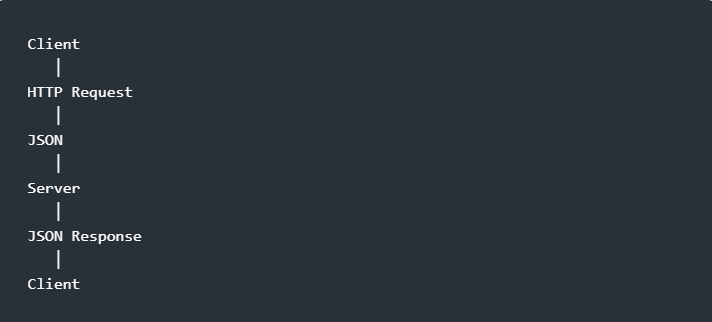
It’s simple, human-readable, and easy to debug.
If you open Postman or your browser, you can immediately understand what’s happening.
That’s one of the biggest reasons REST became the standard for public APIs.
But What Happens Inside Large Enterprises?
Now imagine a company running hundreds of microservices.
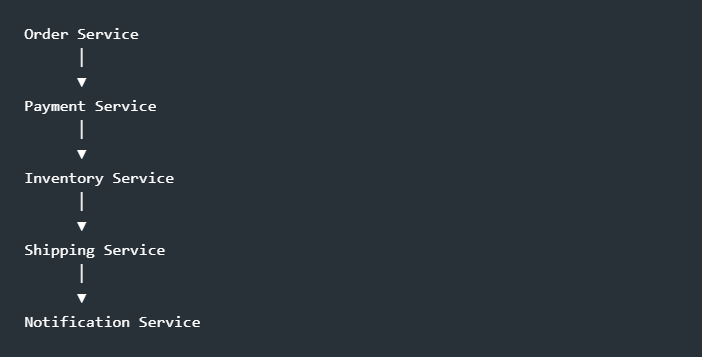
These services may communicate thousands or even millions of times every minute.
At this scale, every millisecond matters.
While REST and JSON work well, they can introduce additional overhead through text-based serialization and the traditional request-response model.
This is one of the reasons Google introduced gRPC to provide a faster, strongly typed, and more efficient way for services to communicate with each other.
So, What Exactly Is gRPC?
gRPC stands for Google Remote Procedure Call.
The core idea is surprisingly simple:
Make calling a service on another server feel like calling a normal function inside your application.
Let’s take a simple Java example.
Imagine you have a service running inside the same application:

This is just a normal Java method call.
Now imagine that 𝗨𝘀𝗲𝗿𝗦𝗲𝗿𝘃𝗶𝗰𝗲 is no longer running in your application. Instead, it’s running on another server in another city.
Normally, you would need to:
- Create an HTTP request
- Convert your Java object into JSON
- Send it over the network
- Wait for the response
- Parse the JSON response
- Convert it back into a Java object
With gRPC, your code still looks almost identical:

But here’s the difference:
𝗨𝘀𝗲𝗿𝗦𝗲𝗿𝘃𝗶𝗰𝗲 isn’t the real service.
It’s a generated client stub.
Behind the scenes, that stub automatically:
- Converts your request into Protocol Buffers (a compact binary format)
- Sends it over HTTP/2
- Waits for the remote server
- Receives the response
- Converts it back into a Java object
From your perspective, it feels like calling a local method.
Under the hood, it’s communicating with another server entirely.
That’s the essence of Remote Procedure Call (RPC).
REST vs gRPC
I found this analogy helpful.
Think of REST as sending an email.
You write everything in plain English. Anyone can read it. Anyone can inspect it. It’s easy to understand.
Now think of gRPC as two computers having a private conversation in a language they’ve already agreed upon.
Instead of exchanging readable text, they exchange compact binary messages.
Humans aren’t expected to read these messages directly.
Computers, however, can process them very efficiently.
Both approaches solve the same problem; they’re simply optimized for different use cases.
Why Is gRPC Faster?
There isn’t just one reason.
Several design decisions contribute to its performance.
1. Protocol Buffers Instead of JSON
REST commonly exchanges data using JSON.
JSON is text-based and easy for humans to read.
gRPC uses Protocol Buffers (protobuf), which serialize data into a compact binary format.
This generally results in:
- Smaller payload sizes
- Faster serialization and deserialization
- Reduced network bandwidth
2. HTTP/2
gRPC is built on HTTP/2.
Compared to traditional HTTP communication, HTTP/2 offers capabilities such as:
- Persistent connections
- Multiplexing multiple requests over a single connection
- Header compression
- More efficient communication
These improvements help reduce latency and improve throughput, especially for high-volume service-to-service communication.
3. Built-in Streaming
REST is typically request-response.

gRPC supports four communication patterns:
- Unary
- Server Streaming
- Client Streaming
- Bidirectional Streaming
This makes it particularly useful for scenarios like:
- Real-time dashboards
- AI inference
- Live tracking
- Chat applications
- IoT
- High-frequency microservices
Does This Mean REST Is Going Away?
Not at all.
REST remains the right choice in many scenarios.
It’s still excellent for:
- Public APIs
- Mobile applications
- Browser-based clients
- Third-party integrations
- APIs that developers need to inspect and debug easily
gRPC isn’t replacing REST.
It’s complementing it.
Many organizations use both.
So Why Does MuleSoft Supporting gRPC Matter?
This is where things get interesting.
Traditionally, enterprise architectures often looked like this:
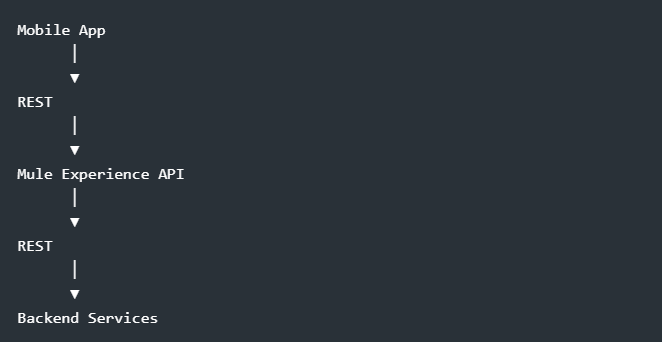
Now they can evolve into something like:
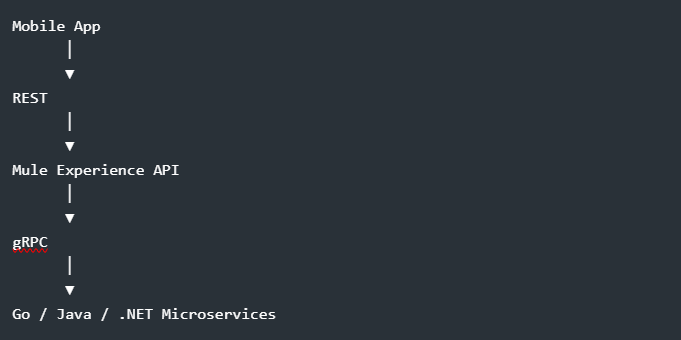
Or even:
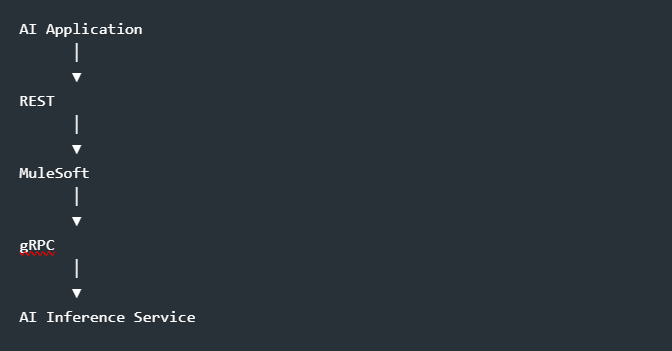
This allows organizations to expose familiar REST APIs externally while communicating with high-performance gRPC services internally; all within the same integration platform.
With MuleSoft’s native gRPC support, developers can design, consume, expose, secure, and govern gRPC APIs alongside REST APIs, bringing both architectural styles under a single API management platform.
My Take
For years, MuleSoft has helped organizations connect APIs, applications, and data across the enterprise.
Native gRPC support extends that capability into the modern microservices world.
As organizations continue adopting Kubernetes, cloud-native platforms, and AI-driven architectures, high-performance service-to-service communication is becoming increasingly important.
Understanding gRPC isn’t just about learning another protocol. It’s about understanding where enterprise integration is heading.
Sometimes the biggest platform updates aren’t the ones that introduce flashy new features. They’re the ones that quietly enable entirely new architectural possibilities.
For me, MuleSoft’s support for gRPC is one of those updates.
Have you started working with gRPC in your projects?
I’d love to hear how you’re approaching REST and gRPC in your integration architecture.