How MuleSoft Supports 140+ LLMs Through Omni Gateway
Introduction
As organizations adopt generative AI, they increasingly use multiple Large Language Models (LLMs) to meet different business requirements. However, managing separate integrations, security policies, and API connections for each model can create complexity.
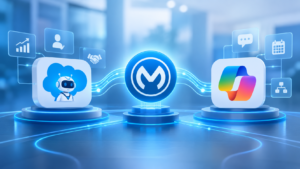
MuleSoft addresses this challenge with its Omni Gateway, which provides a unified way to connect to more than 140 LLMs. It helps organizations simplify AI connectivity while maintaining control over how applications access AI services.
How MuleSoft Omni Gateway Supports 140+ LLMs
The latest expansion makes Omni Gateway more useful for enterprises adopting different AI models. MuleSoft now supports more than 140 LLMs from providers including OpenAI, Anthropic, Google, Amazon Bedrock, Microsoft Azure, Mistral, xAI, and NVIDIA.
This allows development teams to choose models based on their requirements without building a separate integration for every provider.
Read more about MuleSoft’s announcement of support for 140+ LLMs.
Key Benefits for Enterprise AI Integration
1. Unified LLM Access
Instead of maintaining different endpoints for every model, developers can use a single model endpoint. Teams can also introduce new models without changing the applications that consume them.
2. Centralized Security and Governance
Omni Gateway applies consistent policies across LLM interactions. These include authentication, rate limiting, threat protection, and audit logging. This helps organizations maintain control over AI access.
3. Intelligent Model Routing
Organizations can route requests based on the selected model, prompt intent, or request headers. As a result, they can use different models for reasoning, classification, and content generation.
4. Better Cost Management
Not every business task requires an advanced, expensive LLM. Organizations can route simpler requests to faster, lower-cost models and use semantic caching to reduce repeated model calls.
For implementation details, explore the MuleSoft Model Proxy documentation.
Why This Matters for Businesses
Supporting multiple LLMs gives enterprises greater flexibility when building AI-powered applications and agents. They can evaluate emerging models, adapt to changing business requirements, and avoid depending entirely on one AI provider.
More importantly, MuleSoft brings LLM connectivity under the same governance approach used for APIs, MCP tools, and AI agents. This creates a more manageable foundation for enterprise AI adoption.
How NJC Labs Can Help
At NJC Labs, we help organizations build secure and scalable integration architectures using MuleSoft. As enterprises expand their AI initiatives, our MuleSoft expertise can help connect AI services with existing business applications, APIs, and enterprise data.
Explore our MuleSoft implementation services and Universal API Management Support to understand how we help businesses build connected enterprise ecosystems.
We also help organizations explore agentic integration through solutions such as MuleSoft Agent Fabric.
Ready to explore enterprise AI integration with MuleSoft?
Contact NJC Labs to discuss your integration requirements.