How MuleSoft A2A Bridge Connects Agentforce and Microsoft Copilot Studio for Enterprise AI Orchestration
Enterprise AI adoption is accelerating, but connecting AI agents across different platforms remains a significant challenge. Organizations increasingly deploy Salesforce Agentforce for CRM-driven workflows and Microsoft Copilot Studio for business automation. However, these agents often operate independently, limiting their ability to collaborate across enterprise systems.
The MuleSoft A2A Bridge addresses this challenge by enabling AI agents to communicate through the Agent2Agent (A2A) protocol. As part of MuleSoft Agent Fabric, it helps organizations connect existing agents, coordinate workflows, and establish consistent governance without rebuilding their AI investments.
With the general availability of the A2A Bridge for Microsoft Copilot Studio announced in October 2026, enterprises can bring both Agentforce and Copilot Studio agents into A2A-based orchestration workflows.
What Is MuleSoft A2A Bridge?
MuleSoft A2A Bridge is an interoperability capability that makes AI agents compatible with the open Agent2Agent protocol, even when their underlying platforms use different communication methods.
For example, Salesforce Agentforce uses the Agentforce Agent API, while Microsoft Copilot Studio supports interactions through the Direct Line API. These interfaces follow different communication models, making direct coordination challenging.
MuleSoft resolves this through three core capabilities:
- Protocol translation: Converts A2A requests into platform-specific API calls and translates responses into A2A-compatible formats.
- Agent discovery: Generates agent cards that describe available capabilities, allowing orchestrators to identify suitable agents.
- Task lifecycle management: Maps conversations, task identifiers, and execution states across platforms.
Importantly, the bridge operates through MuleSoft Omni Gateway. Therefore, organizations can introduce interoperability without modifying existing agent implementations. Read the official MuleSoft A2A Bridge documentation for technical details.
How Agentforce and Copilot Studio Work Together Through MuleSoft
MuleSoft Agent Fabric provides the orchestration and governance foundation for coordinating agents across platforms.
Conceptual architecture:
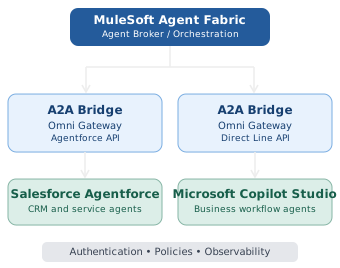
Both bridges expose their source agents through A2A-compatible endpoints, allowing the orchestration layer to discover and communicate with them.
A typical orchestration workflow follows five steps:
- Agent registration: Organizations register existing Agentforce and Copilot Studio agents within MuleSoft Agent Registry.
- Bridge configuration: MuleSoft creates A2A-compatible endpoints and publishes agent cards describing each agent’s capabilities.
- Task delegation: Agent Broker identifies the appropriate agent and routes requests through the corresponding bridge.
- Protocol conversion: The bridge translates requests into native platform interactions and returns compatible task responses.
- Governed execution: Omni Gateway applies authentication and policies, while observability capabilities help teams monitor agent interactions.
Consequently, enterprises can coordinate specialized AI agents without building individual integrations for every agent combination.
Enterprise AI Orchestration: Practical Business Applications
Cross-platform agent orchestration creates opportunities to automate workflows that span CRM, employee productivity, and enterprise applications.
Customer service automation
A Copilot Studio agent could initiate a customer support workflow and delegate CRM-specific tasks to an Agentforce agent. Agentforce could retrieve Salesforce case information, while the orchestrator coordinates the response.
Sales operations
An Agentforce agent could identify an opportunity requiring follow-up. Subsequently, a Copilot Studio agent could support an approved workflow involving internal notifications, document preparation, or team coordination.
Employee onboarding
A Copilot Studio agent could coordinate onboarding activities while an Agentforce agent handles relevant Salesforce records. MuleSoft APIs could connect additional HR or IT systems where required.
These are illustrative implementation scenarios. Actual capabilities depend on agent configuration, available tools, permissions, and enterprise integration architecture.
Security, Governance, and Implementation Considerations
Although interoperability simplifies connectivity, production deployments still require careful security and lifecycle management.
MuleSoft Omni Gateway supports authentication and policy enforcement for bridged agents. However, organizations must configure authorization appropriately, particularly when agents access sensitive business information.
Furthermore, Agentforce and Copilot Studio have different technical limitations. Agentforce supports streaming through its bridge, whereas the Copilot Studio bridge relies on polling and does not support streaming, task cancellation, or push notifications. Copilot Studio task states are also inferred on a best-effort basis.
For Copilot Studio, the source agent sees the bridge identity rather than the original caller. Therefore, user-dependent authentication scenarios require additional architectural evaluation. Organizations can review Microsoft’s documentation on the Agent2Agent protocol to understand the broader interoperability model.
Before deployment, enterprises should validate agent permissions, session handling, timeouts, audit requirements, and failure recovery.
How NJC Labs Enables Cross-Platform AI Agent Integration
As a Salesforce Summit Partner with MuleSoft integration expertise, NJC Labs helps organizations design and implement connected enterprise architectures.
Our approach combines Salesforce Agentforce implementation, MuleSoft implementation services, API-led connectivity, and enterprise governance to support scalable AI initiatives.
NJC Labs can help organizations:
- Assess existing Agentforce and Copilot Studio environments for A2A interoperability.
- Design MuleSoft Agent Fabric architectures and cross-platform orchestration workflows.
- Configure integration patterns, authentication, and governance controls.
- Connect AI agents with enterprise applications through reusable MuleSoft APIs.
- Validate deployment readiness, monitoring, and ongoing operational support.
Our MuleSoft Agent Fabric implementation approach focuses on connecting existing enterprise investments into reliable, scalable workflows rather than introducing isolated AI solutions.
Conclusion
Enterprise AI orchestration requires more than deploying intelligent agents. Organizations also need a secure, standardized way for those agents to discover capabilities, exchange tasks, and collaborate across platforms.
MuleSoft A2A Bridge provides that interoperability layer for Salesforce Agentforce and Microsoft Copilot Studio, while Agent Fabric supports coordinated execution and governance.
Ready to connect your enterprise AI agents?
Partner with NJC Labs to explore MuleSoft Agent Fabric, Agentforce integration, and secure cross-platform AI orchestration.