
Heroku End of Sales
What It Means for Your Cloud and Integration Architecture
Salesforce has stopped new enterprise sales of Heroku. While existing applications continue to run, this change requires organizations to review their Heroku migration plan carefully.
For many businesses, Heroku is not just an application platform. It supports PostgreSQL databases, background processing, Salesforce data syncing, and public APIs. Therefore, when the commercial model changes, technology leaders must understand how deeply the platform is built into their systems and what a clear transition plan should look like.
Schedule a complimentary 1-Hour Architecture Consultation
Understanding Your Migration Options
Replatforming Heroku applications does not automatically improve your architecture. Different destinations solve different problems. Hosting decisions focus on infrastructure control. Architectural decisions focus on how well your integration works and how easily the system can scale over time.
Standardising on Openshift
Integration Impact Beyond Hosting
Infrastructure migration decides where applications run. However, a successful Heroku migration must also address integration governance and long-term data scalability. In many Heroku environments, services developed over time to manage Salesforce and PostgreSQL data syncing, with retry handling and data correction logic built into custom middleware. These patterns typically continue after moving to a new platform unless teams carefully redesign them.
Before selecting AWS, Azure, OpenShift, or Nutanix, it is important to determine whether Heroku is only hosting applications or actively managing critical data flows. A migration moment is therefore an opportunity to separate hosting from integration governance and align data syncing logic with a clearer, long-term architecture.
Case Insight: Redesigning Synchronisation
Challenge
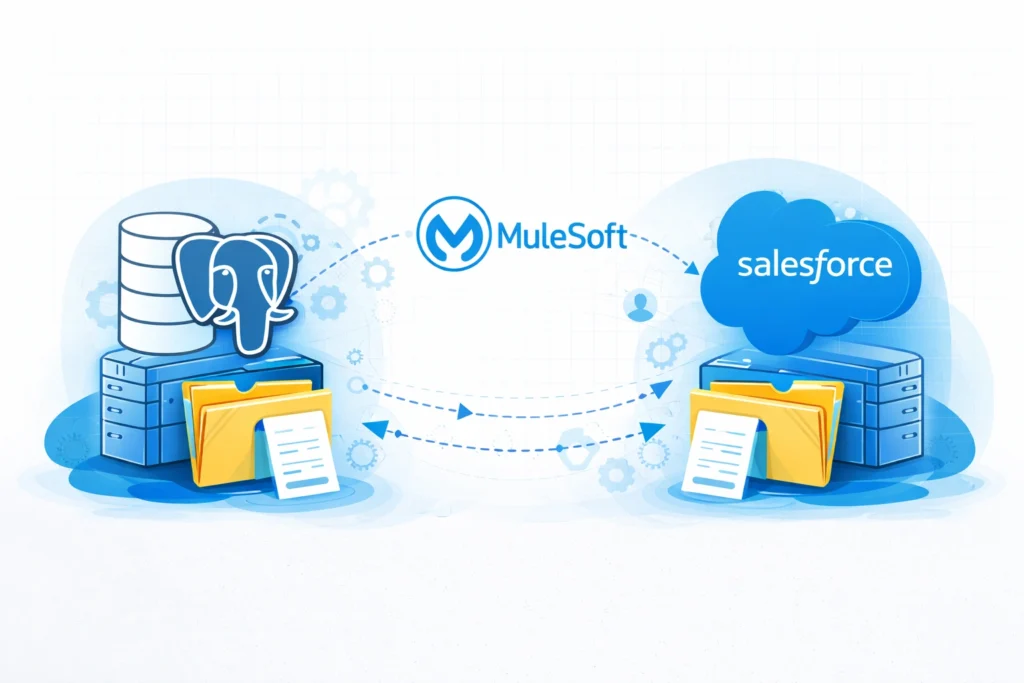
A fast-growing online learning platform expanding internationally was limited by a legacy integration model. At the same time, PostgreSQL ran on Heroku, while Salesforce data syncing lacked governance and scalability. As a result, data inconsistencies increased, and operational inefficiencies began to affect overall performance.
Our Approach
NJC Labs implemented a three-tier MuleSoft API architecture, thereby establishing governed bi-directional synchronisation between Salesforce and PostgreSQL. MuleSoft became the central integration layer, and subsequently, the database was migrated from Heroku to AWS to create a scalable, future-ready foundation. As a result, the client achieved reliable bi-directional data consistency between Salesforce and operational systems. In addition, manual intervention was significantly reduced, visibility across data flows improved, and a scalable API-led foundation was established to support continued growth.
Defining the Right Migration Path
A Heroku review should clarify platform dependencies, separate infrastructure from integration logic, and assess Salesforce database coupling to define the right migration path. At NJC Labs, we help leadership teams on mapping their Heroku footprint and evaluating practical platform options with architectural clarity.