MuleSoft Implementation Experts for Agentforce: From Integration to Intelligent Automation
Enterprise AI does not succeed in isolation. Salesforce Agentforce can help organisations deploy intelligent agents, but those agents need secure access to reliable business data and enterprise systems. That is where MuleSoft implementation experts bring strategic value.
For enterprises investing in Salesforce, MuleSoft and Agentforce, the challenge is no longer simply connecting applications. Instead, organisations need an architecture that connects APIs, data, applications, AI agents, and business processes in a governed and scalable way.
NJC Labs helps enterprises address that challenge through MuleSoft implementation, MuleSoft platform assessment, managed services, Salesforce integration, and Agentforce implementation.
The objective is straightforward: build an integration foundation that allows AI agents to work with trusted enterprise systems rather than operate as disconnected assistants.
Why Agentforce Depends on Enterprise Integration
Agentforce can enable AI agents to assist employees and customers across business processes. However, the value of an agent depends heavily on the context and actions available to it.
Consider an enterprise service agent.
It may need to:
- Retrieve customer information from Salesforce
- Check order status in an ERP
- Access product information
- Validate account eligibility
- Retrieve information from legacy applications
- Trigger downstream business processes
- Update records after completing an approved action
Without reliable connectivity, the agent can only provide limited assistance.
With API-led integration, however, those capabilities can become reusable services that Agentforce and other applications can securely consume.
This is why enterprise AI architecture increasingly depends on the relationship between Salesforce, MuleSoft, APIs, data and intelligent agents.
NJC Labs approaches Agentforce implementation as part of a broader enterprise architecture rather than as an isolated Salesforce configuration exercise.
MuleSoft Implementation Experts for Enterprise Integration
Choosing the right MuleSoft implementation partner becomes particularly important when integration environments span Salesforce, SAP, Oracle, ServiceNow, databases, legacy applications, and cloud platforms.
A successful implementation should address more than whether individual APIs work.
It should consider:
- API-led architecture
- Application and system connectivity
- Reusable integration patterns
- API governance
- Security and access controls
- Error handling
- Monitoring and observability
- Deployment architecture
- Data transformation
- Scalability
- Operational support
NJC Labs provides MuleSoft implementation services for organisations that need to modernise integration while maintaining the reliability of existing enterprise systems.
The approach focuses on reusable integration capabilities rather than creating a growing collection of point-to-point connections.
That matters because every new AI use case can otherwise create another integration dependency.
Instead, organisations can expose governed business capabilities through APIs and make those capabilities available to applications, employees, customers and AI agents.
What Agentforce Implementation Experts Should Solve
An effective Agentforce implementation should start with business outcomes, not simply the decision to deploy an AI agent.
For example, an organisation may want to reduce service resolution time, automate employee requests, improve customer engagement or streamline a complex operational workflow.
The implementation team then needs to determine which data, systems and actions the agent requires.
That typically involves several questions:
What information does the agent need?
- The answer may include Salesforce records, knowledge content, ERP data, customer history or operational information.
Which systems should the agent access?
- The architecture must identify the authoritative source for each business capability.
Which actions can the agent perform?
- Not every process should become autonomous. Sensitive workflows may require validation, approval, or human oversight.
How should access be governed?
- Agents should operate within defined permissions, security policies, and business rules.
How will the organisation measure success?
- Metrics should connect the implementation to business outcomes rather than focusing only on technical deployment.
NJC Labs combines Salesforce, MuleSoft and enterprise integration expertise to help organisations move from AI experimentation towards production-ready agentic workflows.
MuleSoft Platform Audit: Identify Integration Risks Before They Scale
Many organisations already have a substantial MuleSoft footprint. However, integration environments can become difficult to manage as applications, APIs, and business requirements evolve.
A MuleSoft platform audit provides an opportunity to understand the current environment before investing in another major integration or AI initiative.
A structured audit can examine areas such as:
- API architecture
- Application dependencies
- Integration design patterns
- API reuse
- Runtime configuration
- Deployment practices
- Security controls
- Error handling
- Monitoring
- Logging
- Performance
- Scalability
- Governance
- Operational processes
- Technical debt
The purpose is not simply to identify what is wrong.
Instead, the assessment should establish what is working, where risks exist, and which improvements will deliver the greatest business value.
What a MuleSoft Platform Audit Can Reveal
A platform assessment can help answer practical questions such as:
- Are APIs being reused effectively?
- Where have point-to-point integrations increased complexity?
- Which integrations create operational risk?
- Are APIs governed consistently?
- Are monitoring capabilities sufficient?
- Which applications should be modernised?
- Is the current runtime architecture appropriate?
- Can the existing MuleSoft environment support new AI workloads?
- Where can integration costs be reduced?
- Which improvements should happen first?
This creates a technical baseline for future investment.
For organisations considering Agentforce, the audit becomes even more valuable because it can identify whether the current integration landscape is ready to support AI-driven workflows.
From MuleSoft Platform Assessment to Agentforce Readiness
Agentforce introduces a different requirement for enterprise integration.
Traditional applications generally request specific services based on predefined workflows. AI agents can interact with business capabilities dynamically based on user intent, context, and available actions.
Consequently, the underlying integration architecture needs to be discoverable, secure, reliable, and governed.
A MuleSoft platform audit can therefore become the first stage of an Agentforce readiness assessment.
The process can evaluate:
Integration readiness
Are the required enterprise systems connected through reusable APIs?
Data readiness
Can agents access accurate and current business information?
API readiness
Are business capabilities exposed through well-designed and governed interfaces?
Security readiness
Can access be controlled according to users, applications, agents, and business policies?
Operational readiness
Can teams monitor and troubleshoot agent-driven transactions?
Scalability readiness
Can the integration layer support additional agents and use cases without creating excessive complexity?
This approach helps enterprises avoid a common mistake: deploying AI agents before preparing the systems those agents need to operate against.
MuleSoft Managed Services for Continuous Operations
Implementation is only one part of the integration lifecycle.
Once MuleSoft becomes a core part of the enterprise architecture, organisations need a dependable operating model for monitoring, maintenance, optimisation and continuous improvement.
That is where MuleSoft managed services become valuable.
A managed services model can support activities such as:
- Proactive platform monitoring
- Application support
- Incident management
- Performance optimization
- API maintenance
- Runtime support
- Integration troubleshooting
- Deployment assistance
- Platform health checks
- Security and governance support
- Capacity planning
- Continuous improvement
The goal is not simply to respond when an integration fails.
Instead, managed services should help organisations identify potential issues before they affect business operations.
NJC Labs provides MuleSoft managed services, application support, and integration services, helping enterprises maintain the performance and reliability of their integration landscape.
Why MuleSoft Managed Services Matter for Agentic AI
As enterprises introduce more AI agents, integration operations become increasingly important.
An agent may initiate several downstream actions within a single business process.
For example:
- An employee asks an Agentforce agent for customer information.
- The agent retrieves data from Salesforce.
- MuleSoft accesses an ERP system.
- The integration layer transforms and validates the response.
- The agent presents the result.
- The employee approves an action.
- MuleSoft triggers the required downstream process.
If any component fails, the user experience suffers.
Therefore, enterprises need visibility across the entire transaction rather than monitoring only the Salesforce or Agentforce layer.
This is where a combination of MuleSoft observability, application support, and managed services can provide operational continuity.
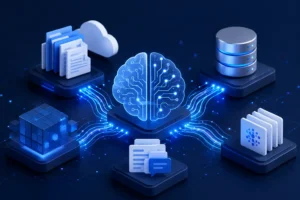
Agentforce and MuleSoft: A Practical Enterprise Architecture
A scalable architecture can separate responsibilities across several layers.
Enterprise systems
Salesforce, SAP, Oracle, ServiceNow, databases, legacy platforms and other systems continue to own their respective business data and processes.
MuleSoft integration layer
MuleSoft provides API-led connectivity between applications and exposes reusable business capabilities.
Data and knowledge layer
Enterprise data, business rules and knowledge provide context for intelligent workflows.
Agent layer
Agentforce and other AI agents use approved capabilities to reason, retrieve information and perform authorised actions.
Governance and operations
Security, monitoring, observability, access controls and human approval processes provide the operational foundation.
This model avoids treating Agentforce as a standalone AI deployment.
Instead, Agentforce becomes part of an enterprise ecosystem.
NJC Labs’ existing work across MuleSoft implementation services, Salesforce Agentforce services and MuleSoft managed services supports this broader implementation model.
Agentforce Use Cases for Enterprise Organisations
Agentforce can support a wide range of enterprise scenarios when the required data and actions are available.
Customer Service Automation
Agents can help service teams retrieve information, answer customer questions, and support defined service workflows.
When Salesforce data needs to be combined with external systems, MuleSoft can provide the integration layer required to access those capabilities.
Employee Service
Internal agents can support employees with common requests involving HR, IT, finance and operational systems.
The integration architecture determines whether the agent can move beyond answering questions and actually initiate approved processes.
Healthcare Workflows
Healthcare organisations can use intelligent agents to simplify selected administrative and service workflows, provided the architecture incorporates appropriate security, data access and governance controls.
NJC Labs also works across healthcare and life sciences and has experience with healthcare data integration.
Financial Services
Financial organisations often operate complex application estates involving core banking platforms, customer systems and regulatory processes.
API-led connectivity can help expose controlled business capabilities while supporting governance requirements.
Sales and Customer Operations
Agentforce can support sales teams with customer context, account information, and workflow assistance.
With the right integration architecture, agents can connect customer information with data from other enterprise applications.
How to Choose MuleSoft and Agentforce Implementation Experts
The right partner should demonstrate more than platform familiarity.
Enterprise buyers should evaluate whether a services provider can connect architecture, implementation, and ongoing operations.
Look for expertise across:
MuleSoft architecture
The partner should understand API-led connectivity and enterprise integration patterns.
Salesforce and Agentforce
The team should understand how Agentforce fits into the broader Salesforce ecosystem and business process architecture.
Enterprise applications
Real-world integrations often involve ERP, legacy, cloud, and specialised platforms.
Security and governance
Enterprise AI and integration require controlled access to sensitive systems and information.
Operational support
The implementation should account for monitoring, incident management and continuous optimization.
Business outcomes
Finally, the partner should connect technology decisions to measurable operational improvements.
NJC Labs brings these capabilities together across MuleSoft, Salesforce, enterprise integration, AI, and application modernization.
A Practical Roadmap for Agentforce and MuleSoft
Enterprises do not need to transform their entire technology landscape before starting.
A phased roadmap can reduce risk.
Phase 1: Assess
Start with a MuleSoft platform audit and identify integration, API, security, data, and operational gaps.
Phase 2: Prioritise
Select Agentforce use cases based on business value, data availability, process maturity and implementation complexity.
Phase 3: Architect
Design the API, data, security, and agent architecture required to support the selected workflows.
Phase 4: Implement
Build and integrate the required capabilities through MuleSoft and Salesforce.
Phase 5: Validate
Test the solution against business scenarios, security requirements, and operational expectations.
Phase 6: Operationalise
Introduce monitoring, support processes, governance and managed services.
Phase 7: Scale
Expand into additional Agentforce use cases and enterprise AI workflows using the reusable foundation already established.
This staged approach helps organisations move from isolated AI experiments towards an enterprise architecture built for scale.
Why NJC Labs for MuleSoft and Agentforce Services?
NJC Labs combines enterprise integration and AI implementation capabilities to help organisations modernise their technology environment without unnecessarily replacing existing investments.
Our services span:
- MuleSoft implementation
- MuleSoft platform assessments
- MuleSoft managed services
- MuleSoft application support
- API-led integration
- Salesforce integration
- Agentforce implementation
- Agentic AI architecture
- Data integration
- Legacy modernization
- Enterprise AI integration
The underlying principle is simple: AI should work with the enterprise systems that already run the business.
That requires reliable integration, trusted data, strong governance and implementation expertise.
For organisations evaluating Agentforce, modernising MuleSoft or looking for a long-term integration partner, NJC Labs can help assess the current environment, define the architecture and execute the roadmap.
Frequently Asked Questions
What does a MuleSoft implementation expert do?
A MuleSoft implementation expert designs and implements integrations using MuleSoft, and is responsible for API architecture, connectivity, data transformation, security, deployment, testing, and operational considerations.
What are Agentforce implementation experts?
Agentforce implementation experts help organisations design, configure, integrate and operationalise Salesforce Agentforce use cases. Their role can extend beyond agent configuration to include data, APIs, enterprise systems, governance and business workflows.
What is a MuleSoft platform audit?
A MuleSoft platform audit is a structured assessment of an organisation’s MuleSoft environment. It can evaluate architecture, APIs, applications, security, performance, monitoring, governance, technical debt, and operational readiness.
Why should enterprises conduct a MuleSoft audit before implementing Agentforce?
Agentforce may need access to multiple enterprise systems. An audit can identify whether the existing integration architecture can securely and reliably support those requirements before the organisation expands its AI footprint.
What do MuleSoft managed services include?
MuleSoft managed services can include platform monitoring, application support, incident resolution, performance optimization, maintenance, troubleshooting, deployment support and ongoing platform improvement.
Can MuleSoft support Agentforce integrations?
Yes. MuleSoft can provide API-led connectivity between Salesforce and external enterprise systems, allowing approved business capabilities and data to participate in broader Agentforce workflows.
How should an enterprise start an Agentforce implementation?
Start with business use cases and assess the required data, systems, APIs, security, and governance. A MuleSoft platform assessment can help determine whether the existing integration environment is ready for the selected Agentforce workflows.
Is a MuleSoft platform audit useful even if the existing integrations work?
Yes. An audit can identify technical debt, duplicated integrations, governance gaps, monitoring limitations and scalability concerns that may not be visible during normal operations. It can also establish a stronger foundation for future AI and integration initiatives.
Build an Enterprise Foundation for Agentforce
Agentforce can become a powerful component of enterprise automation. However, intelligent agents need more than conversational capabilities. They need access to trusted data, governed APIs and reliable business systems.
That makes MuleSoft architecture an important part of the Agentforce conversation.
Whether your immediate requirement is a MuleSoft platform audit, a new integration programme, MuleSoft managed services or an Agentforce implementation, the best starting point is a clear understanding of your existing architecture and the business outcomes you want to achieve.
NJC Labs helps enterprises move from integration complexity to connected, intelligent and scalable enterprise systems.
Ready to assess your MuleSoft and Agentforce readiness? Get started with NJC Labs.