MuleSoft Introduces FIFO Exchange Support in Anypoint MQ
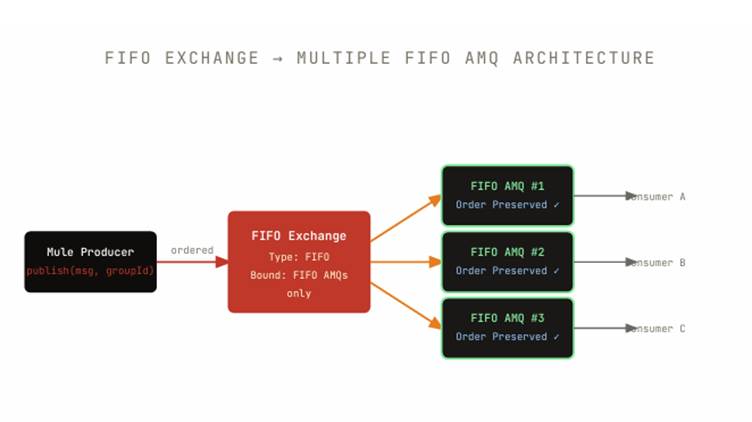
A closer look at ordered message delivery across enterprise integrations at scale and how FIFO Exchanges enable reliable, multi-consumer integration patterns where message order is critical.
For years, MuleSoft Anypoint MQ has been a reliable, cloud-native messaging solution tightly integrated with the Mule runtime. However, developers building order-sensitive integration flows often encountered a significant limitation: standard exchanges could not guarantee message ordering. The broker could distribute messages to multiple queues, but consumers received them in a sequence determined by the broker. For industries such as finance, healthcare, retail, and logistics, where event order directly impacts business accuracy, this became a major architectural challenge.
To address this, development teams often relied on complex workarounds such as:
- Single-partition FIFO queues
- Custom sequencing logic within Mule applications
- Point-to-point routing with custom ordering middleware
Although these approaches worked in some scenarios, they increased application complexity, reduced scalability, and shifted messaging responsibilities into the application layer. That changes with the introduction of FIFO Exchange support in Anypoint MQ for ordered message delivery across enterprise integrations.
With FIFO Exchanges, organizations can now publish a message once and ensure every connected FIFO queue receives messages in the exact order they send them. This enables ordered message distribution across multiple consumers without requiring custom sequencing logic.
Previously, architects had to choose between:
- Ordered delivery using a single FIFO queue
- Broad message distribution using standard exchanges without guaranteed ordering
FIFO Exchange support now combines both capabilities by enabling ordered message distribution across multiple FIFO queues simultaneously.
Understanding the Previous Limitation
Standard Anypoint MQ Exchanges follow a publish-subscribe model. A producer publishes a message to an exchange, and the exchange distributes copies of that message to all connected queues.
This model works well for:
- Notifications
- Cache invalidation events
- Event-driven triggers
- General asynchronous processing
However, standard exchanges prioritize throughput over message sequencing.
FIFO queues, introduced earlier in Anypoint MQ, addressed message ordering for point-to-point communication. They also support an optional messageGroupId, which helps maintain ordered processing within logical message groups while enabling parallel processing. The challenge started when multiple downstream systems needed to independently process the same ordered message stream.
Architects had only three imperfect options:
1. Single FIFO Queue with Multiple Consumers
This preserved message order, but all consumers competed for the same messages. Independent processing by multiple downstream systems was not possible.
2. Standard Exchange with Multiple FIFO Queues
Each consumer received its own copy of the message, but the system could no longer guarantee message order. Teams also needed additional application logic to restore the correct sequence.
3. Custom Sequencing Middleware
A dedicated Mule application consumed messages from a FIFO queue and redistributed them sequentially to downstream queues. This introduced additional latency, operational overhead, infrastructure cost, and new failure points.
What Is FIFO Exchange in Anypoint MQ?
FIFO Exchange is a new exchange type in Anypoint MQ that enforces ordered message delivery across enterprise integrations at the exchange level.
The core principle is straightforward:
- A FIFO Exchange can only be connected to FIFO queues
- Standard queues cannot be attached to a FIFO Exchange
This design enables the broker itself to maintain ordering from producer to consumer.
In simple terms:
Publish once to a FIFO Exchange, and every connected FIFO queue receives messages in the same order enforced by the broker rather than application code.
How FIFO Exchange in Anypoint MQ Works
FIFO Exchange extends FIFO queue capabilities to support ordered distribution across multiple queues.
1. Ordered Message Processing
Messages published to a FIFO Exchange are processed in the same sequence in which they are received.
If required, developers can optionally provide a messageGroupId to create multiple ordered streams within the same FIFO flow. This allows parallel processing while maintaining order inside each group.
For example:
- Messages with orderId = 1001 remain ordered
- Messages with orderId = 1002 remain ordered independently
This improves scalability without sacrificing sequencing.
2. Exchange-Level Distribution
The exchange sequences messages before distributing them to connected FIFO queues.
For example, if a FIFO Exchange is connected to three FIFO queues:
- Message 1 is delivered to all three queues first
- Message 2 is delivered only after Message 1 in sequence
This guarantees consistent ordering across all downstream consumers.
3. FIFO-Only Queue Binding
Anypoint Platform prevents standard queues from being connected to FIFO Exchanges. This restriction is intentional because connecting non-FIFO queues would break the end-to-end ordering guarantee.
Configuration Overview
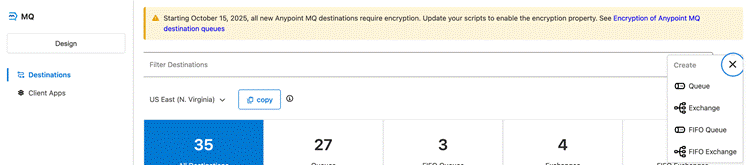
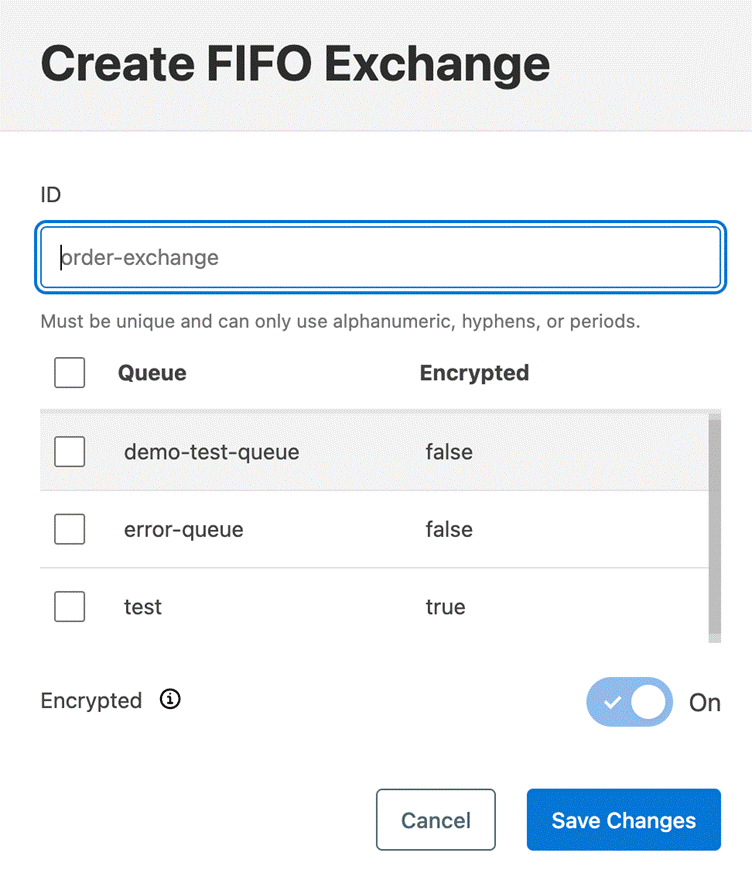
Step 1: Create a FIFO Exchange
In Anypoint Platform:
- Navigate to MQ → Exchanges
- Create a new exchange
- Select FIFO as the exchange type
Step 2: Create FIFO Queues
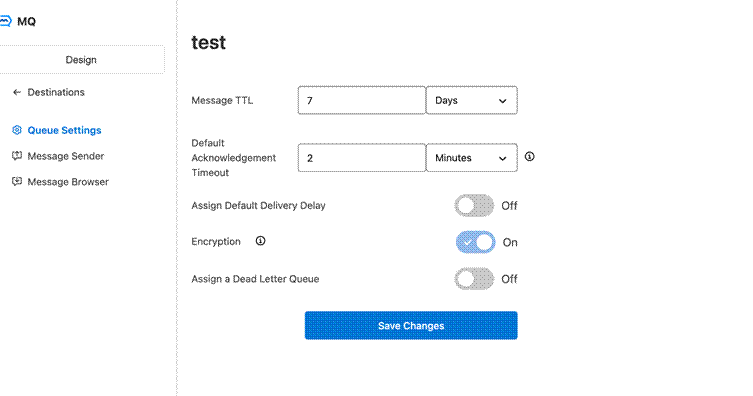
Create the destination queues and enable the FIFO Queue option.
Configure settings such as:
- Message TTL
- Default acknowledgement timeout
- Delivery delay
- Dead Letter Queue (DLQ)
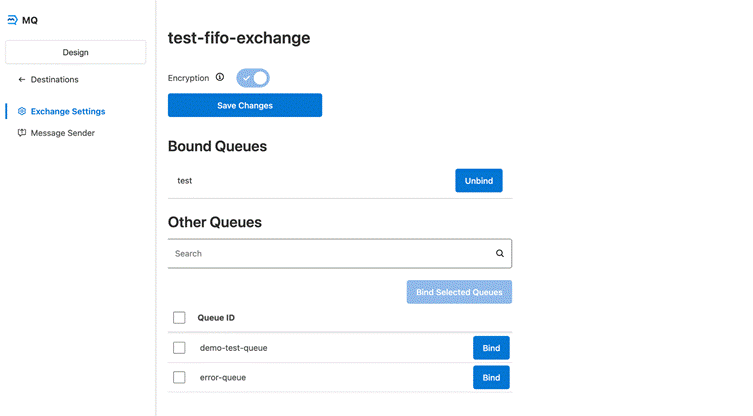
Step 3: Connect FIFO Queues to the Exchange
Bind the FIFO queues to the FIFO Exchange.
The platform automatically prevents standard queues from being attached.
Step 4: Publish Messages
Publish messages to the FIFO Exchange using the Anypoint MQ Connector.
Optionally, include a messageGroupId if parallel ordered processing is required.
Step 5: Consume Messages from FIFO Queues
Each downstream Mule application consumes messages from its dedicated FIFO queue.
Ordering is maintained automatically, reducing the need for custom sequencing logic.
Business Use Cases for FIFO Exchange Anypoint MQ
FIFO Exchanges simplify several integration scenarios that previously required custom implementations, including:
- Order processing pipelines
- Financial transaction sequencing
- Healthcare record synchronization
- Manufacturing and IoT event streams
- Ticketing and reservation systems
Any use case where event order impacts business correctness can benefit from this capability.
Important Design Considerations
FIFO-Only Connections
FIFO Exchanges support only FIFO queues. Queue topology should be planned carefully before implementation.
Optional messageGroupId
Unlike some messaging platforms, messageGroupId is optional in Anypoint MQ FIFO configurations.
Without a group ID:
- The entire queue behaves as a single ordered stream
With a group ID:
- Multiple ordered streams can be processed in parallel while preserving sequence within each group which will increase the throughput.
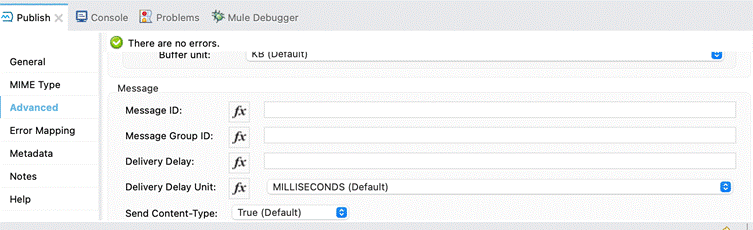
- Message IDs uniquely identify each message
- Message Group ID preserves ordering across related messages by grouping together
Regional Availability
FIFO Exchange support depends on regional availability within Anypoint MQ. Always verify support in the latest Anypoint Platform release documentation.
Dead Letter Queues (DLQ)
- Each FIFO queue should have an associated Dead Letter Queue for failed messages.
- If preserving the order of failed messages matters, configure the DLQ as a FIFO queue as well.
Final Thoughts on FIFO Exchange Anypoint MQ
FIFO Exchange support in Anypoint MQ for ordered message delivery across enterprise integrations addresses a long-standing challenge in enterprise integration architectures. Previous approaches, custom sequencing logic, middleware redistribution, and complex queue topologies introduced unnecessary operational overhead and maintenance complexity.
By enabling the broker itself to enforce ordered delivery across multiple consumers, FIFO Exchanges simplify distributed integration patterns while maintaining scalability and reliability. The restriction that FIFO Exchanges can only connect to FIFO queues is not a limitation; it is the foundation that makes consistent ordering possible.
For organizations building MuleSoft integrations where event sequence is critical and multiple downstream systems must independently process the same ordered stream, FIFO Exchange provides a clean, scalable, and reliable solution. With proper queue design, optional messageGroupId usage where needed, and idempotent consumers, teams can now achieve both scalability and ordered message distribution without relying on custom sequencing implementations. The trade-off between ordered delivery and scalable message distribution is no longer necessary.