Automating Purchase Order Generation with MuleSoft RPA and Anypoint Platform
This case study highlights how a component manufacturing company leverages the Hyperautomation of MuleSoft RPA with MuleSoft Anypoint Platform solution, developed by NJC Labs, to integrate its inventory management and ERP systems and automate the purchase order (PO) generation process.
Challenge
The warehouse currently manages its inventory through four key activities: receiving, putaway, picking, and packing. The company performs these activities using a legacy RFID and barcode (2D matrix) system.
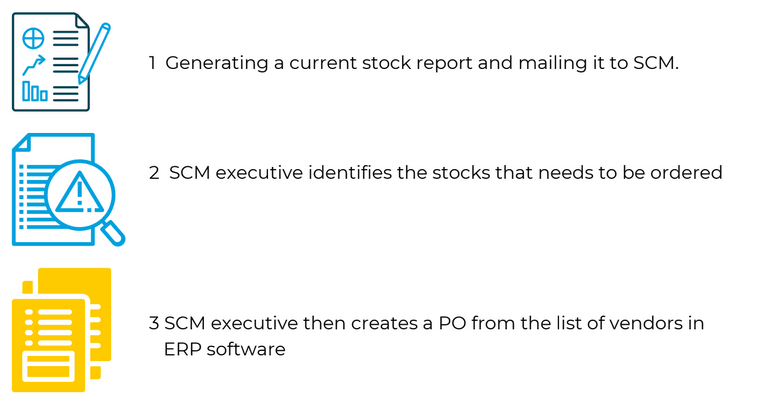
At the end of each day, the warehouse manager extracts inventory updates from the system and emails them to the SCM executive. Based on the reorder points of available stock, the executive manually creates purchase orders for the following day.
However, this manual approach falls short of Industry 4.0 standards and creates additional workload for the SCM team. The management wants to automate the purchase order generation process without replacing its established applications. Therefore, the company is looking for a solution that integrates with its existing systems, streamlines inventory management, and reduces manual effort for the SCM team.
The goal is to free up the team’s time from repetitive tasks, so that they can focus on more important tasks. While there are many tools available in the market, the management is seeking a solution that can work in tandem with their existing system.
Objective
The objectives for a solution are highlighted below.
- Improved supply chain management
- Reduced manual work
- Increased efficiency
- Better visibility
Understanding the Process
Let us break the process into three steps:
Solution
Hyperautomation tools used:
- MuleSoft RPA – The bot can be deployed on the Windows system operating the legacy inventory management system.
- Anypoint Platform – Cloud-based platform to integrate the inventory management system and ERP system.
- MuleSoft RPA streamlines repetitive tasks and grants accessibility to legacy systems. Meanwhile, the Anypoint Platform facilitates seamless integration between various systems as follows:
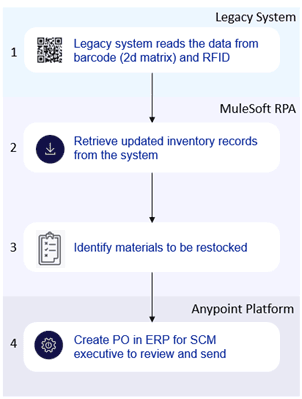
The numbers below indicate what is happening at each part of the process.
- 1. The system registers inventory using legacy RFID and barcode systems.
- 2. An RPA bot retrieves inventory records from the legacy system. The bot performs this task at fixed, scheduled intervals according to business requirements.
- 3. The RPA bot identifies stocks that need replenishment by comparing inventory levels with their reorder points.
- 4. Once the team publishes the RPA process to production, users can access the application through Anypoint Exchange. The ERP system integrates with the bot through the Anypoint Platform to automate purchase order creation.
Once the system creates the purchase orders, it either submits them automatically or sets them aside for review by an SCM Executive before submission. DataWeave, MuleSoft’s functional programming language for data transformation, evaluates custom conditions to determine the appropriate action.
Results
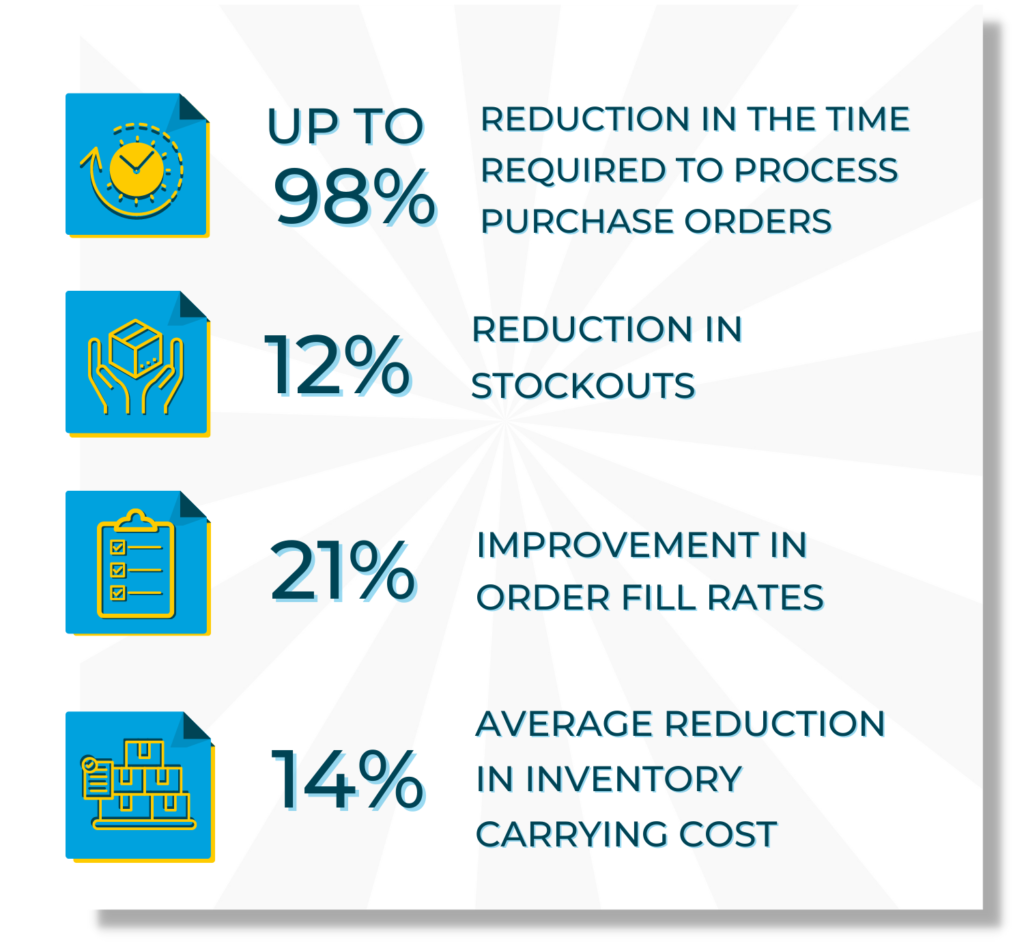
The results of this simple integration are
Related Case Study: Automating Invoice Processing with MuleSoft
Explore how NJC Labs helped a large logistics company automate invoice processing by integrating MuleSoft IDP, RPA, and ERP systems.