Deploying a MuleSoft Application to the CloudHub 2.0 Mumbai Region
Taking CloudHub 2.0 Mumbai from Availability to Validation
Following our exploration of MuleSoft’s India-focused infrastructure initiatives, the NJC Labs engineering team conducted a proof of concept (POC) to validate application deployments on the CloudHub 2.0 Asia Pacific (Mumbai) region.
The objective was simple: deploy a lightweight Mule application and verify the end-to-end deployment experience on the Mumbai target.
This hands-on exercise allowed us to assess deployment capabilities and establish a baseline for future customer implementations.
POC Objective
The purpose of this POC was to validate:
- Deployment to the CloudHub 2.0 Shared Space – Asia Pacific (Mumbai) target
- Runtime availability and application accessibility
- End-to-end deployment workflow using Runtime Manager
- Readiness for future enterprise workloads
POC Architecture
The architecture used was intentionally simple.
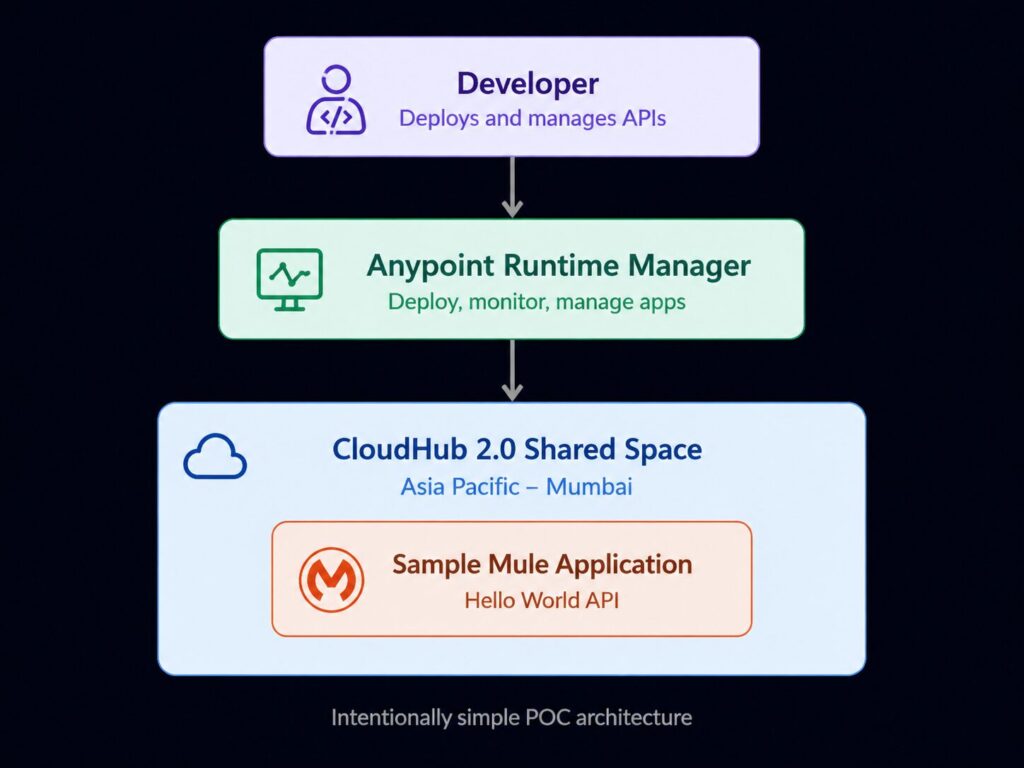
The sample application exposed a simple HTTP endpoint that returned a static response.
Although lightweight, this deployment validated the same deployment process that would be used for larger enterprise integration workloads.
Deployment Steps
The POC was executed using the following steps:
Step 1: Build a Sample Mule Application
We created a basic Mule application containing:
- HTTP Listener
- Simple Transform Message component
- Static JSON response
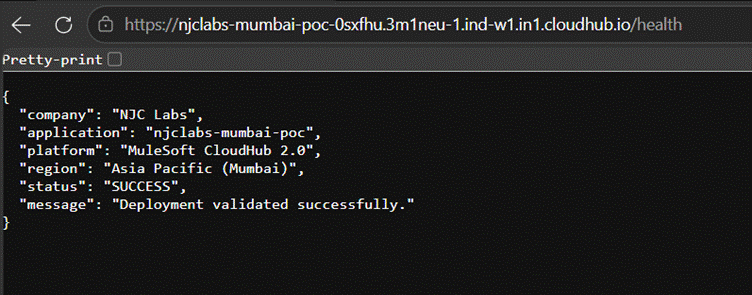
Example response:
{ “company”: “NJC Labs”, “platform”: “MuleSoft CloudHub 2.0”, “region”: “Asia Pacific (Mumbai)”, “status”: “SUCCESS”, “message”: “Deployment validated successfully.” }
Step 2: Select the Deployment Target
Within Runtime Manager, we selected:
CloudHub 2.0 → Shared Space → Asia Pacific (Mumbai)
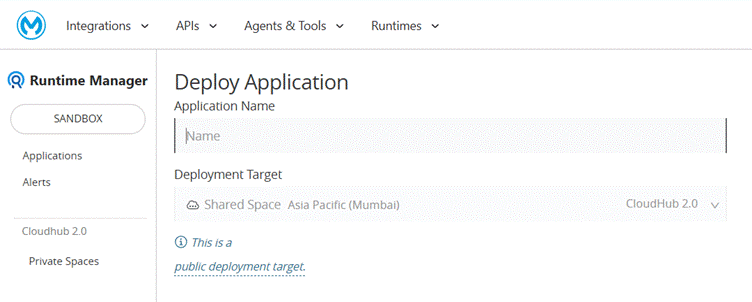
This confirmed that our organization has access to the Mumbai deployment region.
Step 3: Configure Runtime Settings
The application was deployed using:
- Mule Runtime 4.x
- Java 17
- Edge release channel
- Single replica deployment
Step 4: Validate the Deployment
After deployment, we verified:
- Application startup status
- Endpoint accessibility
- Runtime availability
- Successful HTTP responses
What This POC Demonstrates
This proof of concept validates that applications can be successfully deployed and executed on the Mumbai deployment target.
For organizations operating in India, regional deployments can offer several advantages:
Improved User Experience
Deploying workloads closer to users and connected systems can reduce network latency and improve application responsiveness.
Support for Data Residency Strategies
Organizations can design architectures that align with local data governance and residency requirements.
Infrastructure location is one component of broader compliance initiatives and should be combined with organizational security and governance practices.
Cloud-Native Scalability
CloudHub 2.0 uses a container-based architecture that supports scalable deployments and application growth as business demands evolve.
Key Learnings
Our POC highlighted several observations:
- Deploying to the Mumbai target is straightforward using Runtime Manager.
- Teams can deploy existing Mule applications without making application code changes.
- Regional deployment options provide greater architectural flexibility.
- Teams can use the same deployment process for enterprise APIs and integration services.
Conclusion
This proof of concept shows that MuleSoft CloudHub 2.0’s Mumbai deployment target is ready to support integration applications closer to users and systems in India.
As organizations continue to update their integration environments, regional deployment options provide another important foundation for building fast, scalable, and reliable architectures.
At NJC Labs, we continue to test and confirm new MuleSoft capabilities to help our customers adopt modern integration approaches with confidence.